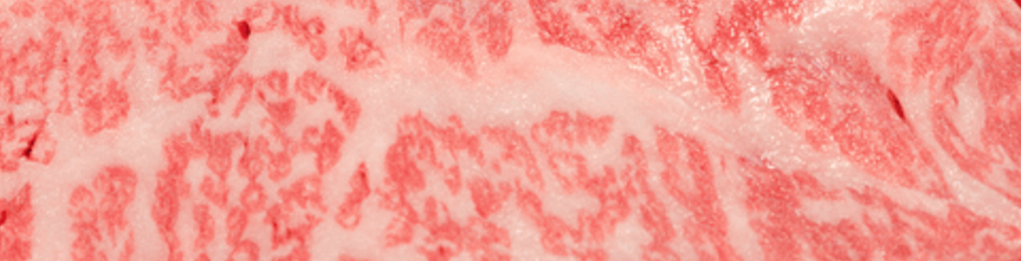
"Wagyu" literally means "Japanese cattle" — wa (Japanese) and gyu (cattle). It is used loosely to describe any cattle from Japan, but it is not the name of a single breed. It is an umbrella term covering several distinct native breeds, each with its own history, herdbook and identity.
For most of their history these animals were never bred for the table. They were living machinery — hardy, patient draft cattle that pulled plows through terraced rice paddies and hauled loads across mountainous country. Their fine-grained, heavily marbled meat was a fortunate byproduct of a physiology built for sustained work. Japan's mountainous geography kept regional populations separate for generations, and for long stretches the eating of beef was discouraged under Buddhist influence, so the cattle were shaped almost entirely by their working role and their local environment. Distinct regional strains emerged. Only in the 20th century — as mechanization freed the cattle from the fields — did breeders turn their full attention to carcass quality, and in doing so refined the most intensely marbled beef in the world.
The Four Japanese Breeds
Although the term is used loosely for all cattle from Japan, four distinct breeds were developed there:
- Japanese Black (黒毛和種 Kuroge Washu) — the intensely marbled black cattle that make up over 90% of the fattened cattle in Japan, and what nearly everyone means in casual conversation when they say "Wagyu."
- Japanese Brown / Japanese Red (赤毛和種 Akage Washu), known as Akaushi — the reddish-gold cattle native chiefly to Kumamoto and Kochi.
- Japanese Polled (無角和種 Mukaku Washu) — a small, naturally hornless breed.
- Japanese Shorthorn (日本短角和種 Nihon Tankaku Washu) — a lean breed making up less than one percent of all cattle in Japan.
Only the Japanese Black and the Akaushi reached the West in numbers before Japan closed its export door.
Black Wagyu vs. Akaushi — the Distinction That Matters
Here is the point that causes more argument among breeders than almost any other:
Akaushi are Wagyu in the literal sense — they are Japanese cattle — but they are a separate breed from the Japanese Black, not a red color variety of it.
The common marketing phrase "Red Wagyu" blurs that line and irritates a lot of serious breeders, because it implies the reds are simply the Blacks in a different coat. They are not. The Akaushi has always been called Akaushi ("red cow") by local breeders in Kumamoto, on the island of Kyushu. Akaushi grow larger and faster, milk well, carry a favorable higher-oleic fat profile, and perform strongly on grass — a different animal, with its own breed identity, its own herdbook and its own breed associations. The accurate way to say it: there is Black Wagyu (Japanese Black), and there is Akaushi — both Japanese cattle, each its own breed. This education hub uses Akaushi throughout for the Kumamoto/Kochi reds, and reserves the plain term "Wagyu" for the Japanese Black where common usage expects it.
The Strains — the DNA of the Japanese Black
The Japanese Black is not one uniform population but a blend of distinct strains (keito), each historically tied to a prefecture and a breeding emphasis. Understanding them is the key to reading any modern pedigree, because breeders still blend these lines deliberately to balance marbling against growth. The vintage WagyuRanch material groups them the way Japanese breeders talk about them — by prefecture and by the sire line that defines them.
Tajima (Hyogo Prefecture) — the marbling engine. Compact, smaller-framed and slower-growing, the Tajima line produces the finest, most abundant intramuscular fat of any strain, and it is the genetic foundation of Kobe beef. Its trade-off is size: Tajima cattle are lighter and yield less, so the line is prized for quality over quantity. Roughly half of the average full-blood genetics outside Japan trace to Tajima. Within Tajima, breeders speak of sub-lines such as the Doi (Yasumi Doi) blood prized in Hyogo.
Kedaka (Tottori Prefecture) — the growth-and-frame line. Originally bred as pack animals in the grain trade, Tottori cattle contribute size, skeletal structure, mature weight and feed efficiency while still holding respectable marbling. Kedaka blood is the classic outcross for adding frame and ribeye to marbling-heavy herds. Note a distinction the vintage material is careful about: the Youhou line of Tottori is not the same as the Kedaka sub-strain — Youhou-line Tottoris carry no descent from the bull "Kedaka" himself. (The 1976 import bull Mazda is described in the WagyuRanch material as a Youhou-line Tottori — see the fact-check note in the import history.)
Fujiyoshi / Itozakura (Shimane-centered) — the balanced line, built largely on the great sire lineage of Dai 7 Itozakura. Fujiyoshi offers a middle path: good marbling combined with genuine maternal ability, milk and moderate growth. It is the line breeders reach for to build productive cow herds. The famous zero-Tajima marbling sire Itohana — twice the #1 marbling sire in all of Japan — is a Fujiyoshi, as is the original import bull Kenhanafuji.
Shimane — closely associated with the Fujiyoshi world; valued for combining growth and strong carcass performance with milk, and prized in Japan for a fat quality that many domestic consumers actually prefer over Tajima.
Tottori and Okayama — the other historic prefectural strains of the Japanese Black. Tottori is synonymous with the Kedaka growth-and-frame contribution above; Okayama is one of the classic regional lines.
Those strains all belong to one breed — the Japanese Black. The Akaushi, meanwhile, carry their own strains, chiefly Kumamoto and Kochi.
Why the Strains Still Drive Every Pedigree
For a long time — through the "Kobe" boom of the 1980s and 90s — Japanese and Western breeders stacked Tajima on Tajima, chasing marbling above all. Japan itself has since swung hard toward Kedaka and Shimane blood: in recent years the top bulls in Japan have averaged well over half Kedaka and roughly a third Shimane, with less than a fifth Tajima — close to the reverse of most Western herds, which are still Tajima-heavy. Kedaka-x-Shimane carcasses marble comparably (many say preferably) while growing 20–30% larger on months less feed, which is why bulls that can dilute Tajima without losing marbling — the zero-Tajima Fujiyoshi/Shimane sires like Kenhanafuji and Shigefuku — are so highly prized outside Japan. If you think of the prefectural bloodlines as spices in a recipe, the whole art of Wagyu breeding is blending Tajima's marbling, Kedaka's frame, and Shimane/Fujiyoshi's balance into a single animal.
Wagyu and Health
Wagyu cattle's genetic predisposition yields a beef that contains a higher percentage of omega-3 and omega-6 fatty acids than typical beef. The heavy intramuscular marbling also raises the ratio of monounsaturated fats to saturated fats — one reason Wagyu, and Akaushi in particular, is often described as a healthier fat profile than conventional beef.